 |
|
Perry Dale is a
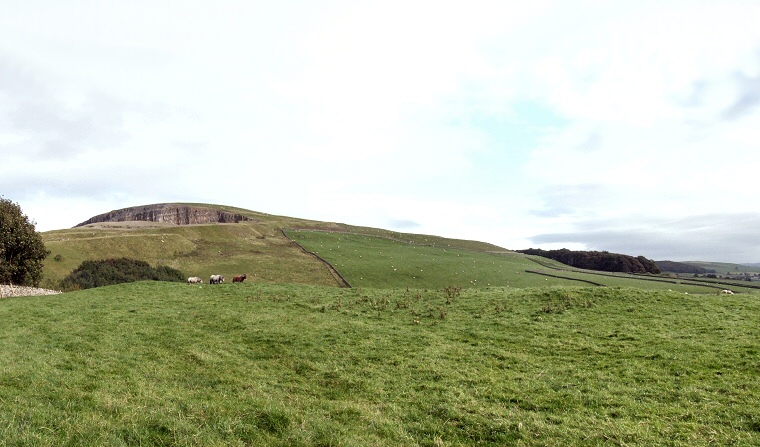
composite monument that stands in the shadow of Eldon Hill which as
can be seen from the photograph above is the site of a large scale limestone
quarrying operation which extends to within 200 metres of the site.
The first monument on this site was a Neolithic long barrow that was oriented northeast to southwest and measured about 55 metres in length by just over 25 metres wide. The remains today stand less than a metre tall and can be seen as the low elongated mound stretching nearly to either side in the foreground of the photograph which shows the view looking east. The site retained its importance into the Bronze Age, perhaps due to its position beneath the hill which dominates the landscape and was chosen as the site of a round barrow. Interestingly the barrow was not placed alongside or close to the preceding long barrow but superimposed over its northeastern end (at the left-hand side in the image above, in front of some bushes and to the left of the ponies). The round mound that remains today stands about a metre tall and covers an area of 25 metres in diameter but it has been badly cratered around it's top, however there is some uncertainty as to what caused this damage. English Heritage suggest it was either done in the mid to late 18th century by quarrying for limestone, at which time the antiquarian William Bray reported the finding of a large number of human bones. Alternatively it could be as a result of investigations by Rooke Pennington in the latter half of the 19th century whose excavations revealed the presence of a pair of cists constructed of limestone which contained remains of 'funerary pots' . Perry Dale seems to have been a focus of activity in prehistory, as well as these monuments there are also a pair of barrows on Eldon Hill, one on the summit, one on the southeastern slope while a short distance to the west Gautries Hill also carries a pair of barrows, one on the summit and another on its southern slopes. |
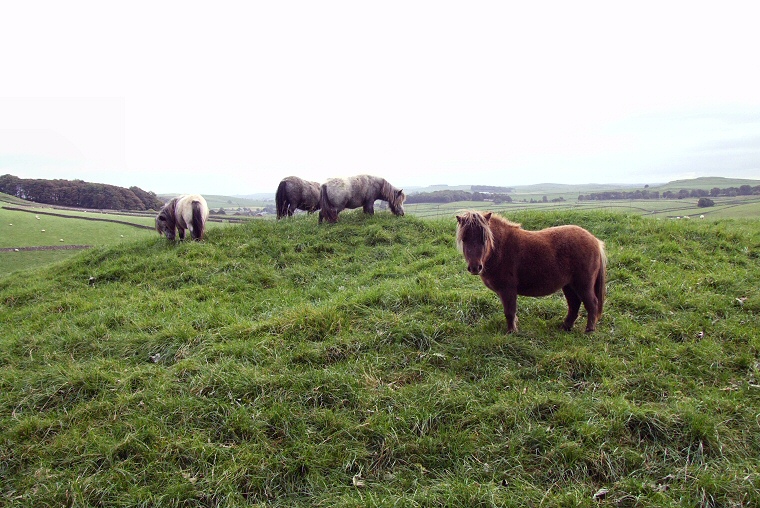 The round barrow looking south, the crater is probably the result of quarrying in the 18th century. |
Back to Map | Home | Full Glossary | Links | Email: chriscollyer@stone-circles.org.uk
