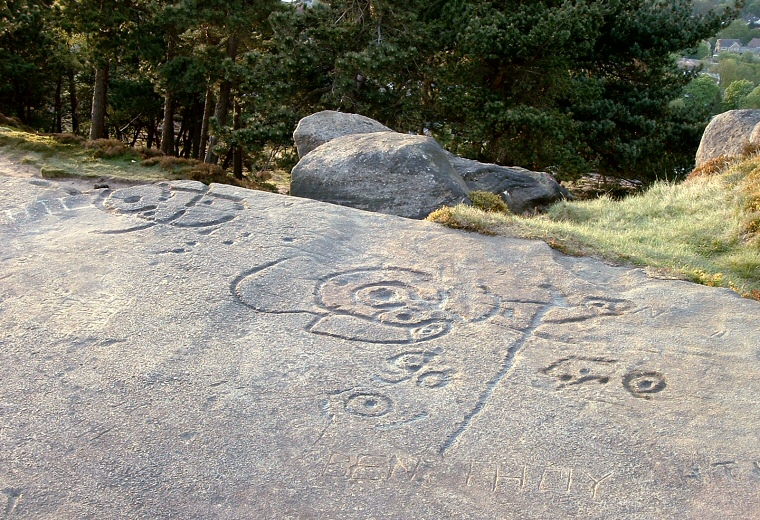
There are five sets of patterns spread out over the surface of the rock. On the eastern area are the two most easily identifiable designs, the largest motif consists of a deep central cup with double joined arcs and extending grooves, one of which has a peculiar kink in it as it curves away to the west before turning sharply to the north. Just to the east of the pattern a deep groove runs northwest-southeast. On either side of it are about half a dozen cups, three rings and several unfinished rings or grooves. To the west is the second motif that seems to have been damaged by quarrying, again it has an almost central cup, this time with a ring that a doesn't quite meet and a pair of grooves extending from either side that curve in and also do not quite meet. Through the middle of these two elements is a half circle groove which also has an uncut centre. Between the two main motifs, five cups and a small groove form a triangle.
Of the other three motifs, which can be difficult to find (photographs at the bottom of page), one consists of a complex series of grooves containing links and cups and could almost be imagined to be a representation of a map (carving 3 below), it measures about 60cm by 40cm. The next set of carvings form four incomplete or eroded rings surrounding cups, the largest, which measures 46cm by 40cm has a pair of deep rings around a keyhole shaped cup (carving 4). The final design is rather vague, it appears to be an incomplete ring with one end veering away at an angle. There is a single cup at the centre and the whole motif is around 32cm by 28cm (carving 5).
Within the last few years someone has carved a Celtic knotwork pattern into the rock just a few feet away from these Bronze Age rock marks - is this modern vandalism or a continuation of an ancient tradition?
The easiest way to get to the Hanging Stones carvings is to head out of the carpark, walk past the Cow and Calf rocks, take a right turn and follow the track to the old quarry.
PRAWR = Prehistoric Rock Art of the West Riding (Boughey and Vickerman 2003)
See also Ilkley Moor & Rombalds Moor Introduction
Date: Bronze Age
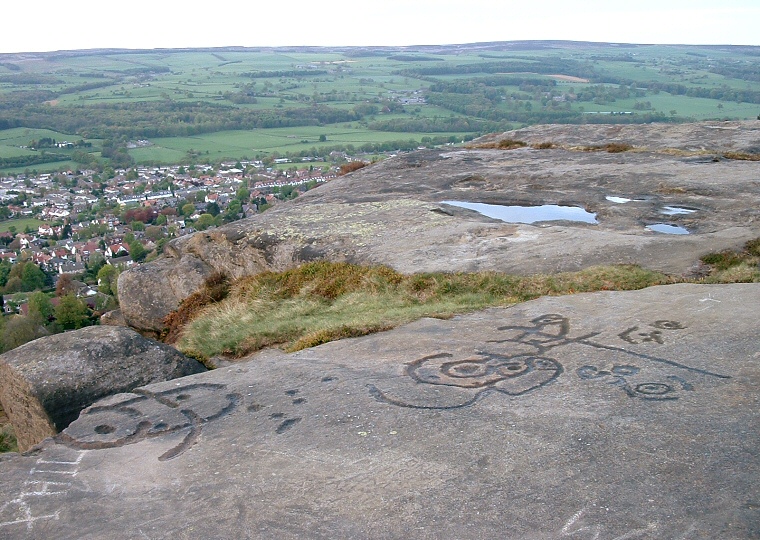
The two sets of eastern carvings with the town of Ilkley beyond.
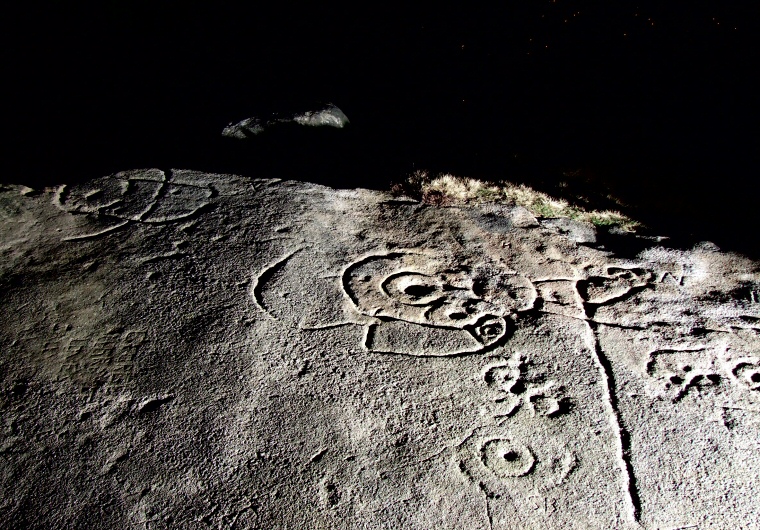
The Hanging Stones eastern carvings lit by flash.
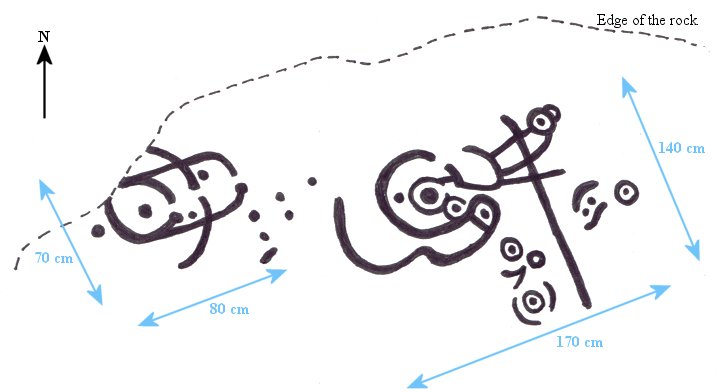
Plan and measurements of the eastern carving.
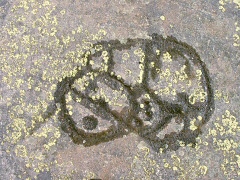
Carving 3
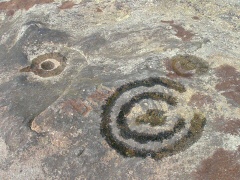
Carving 4
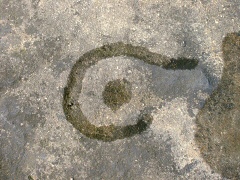
Carving 5
